
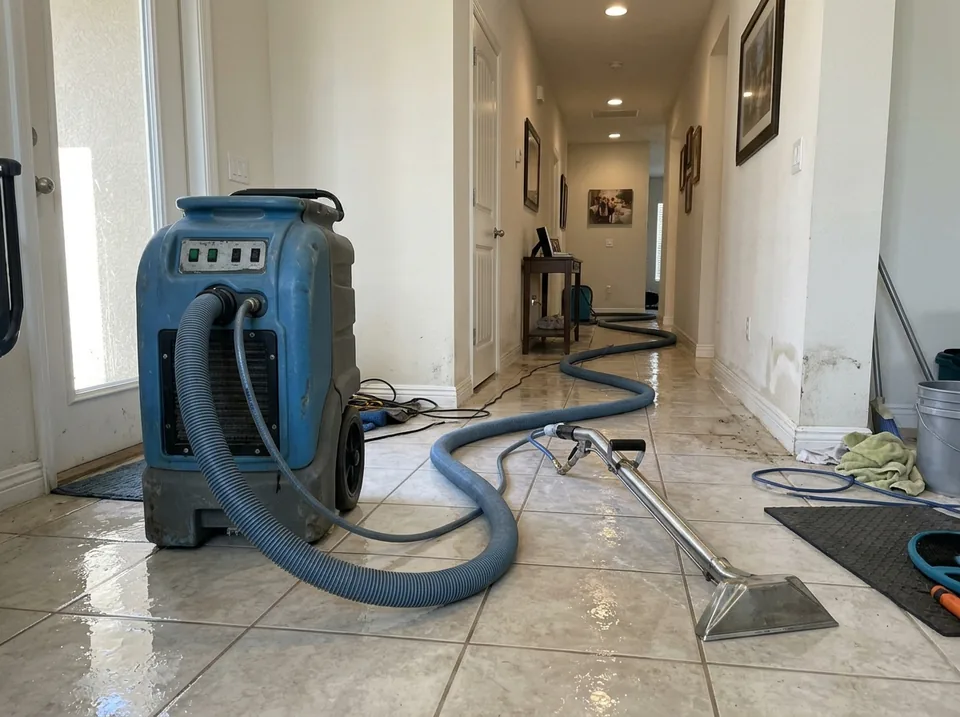
In the first 24 hours after discovering water damage in San Jacinto, prioritize safety first: shut off the water supply, cut power to wet circuits from a dry area, photograph all standing water and affected rooms, call an independent local mitigation crew for rapid extraction, and avoid running household vacuums or sealing damp rooms without dehumidification.
Why Do the First 24 Hours Matter So Much in San Jacinto Homes?
Water behaves differently inside a modern Southern California home than most homeowners expect. Within minutes of a ruptured washing machine hose in De Anza or an overflowing garage water heater in Spice Ranch, liquid water follows gravity into floor seams, carpet padding, and expansion gaps between concrete slabs and wood framing. Within one to four hours, porous gypsum drywall begins wicking moisture vertically—a process called capillary action—pulling water well above the visible puddle line on the floor.
By hour 12 to 24, particleboard kitchen toe-kicks and bathroom vanities begin to swell permanently, latex wall paint blisters as vapor pushes outward, and metal fasteners or tack strips start oxidizing. Between 24 and 48 hours, dormant mold spores present in every indoor environment find the exact moisture and cellulose food source they need to colonize inside dark wall cavities. Acting systematically during the first 24 hours often determines whether a home needs a straightforward three-day dry-out or an expensive multi-week tear-out and rebuild.
Whether you are dealing with a clean supply-line break or storm runoff, connecting quickly through our San Jacinto water damage restoration referral line helps you move from panic to a documented, methodical recovery plan.
Hour 0 to Hour 1: Immediate Safety & Water Shutoff Protocol
Before stepping into standing water, pause for thirty seconds and assess electrical, structural, and contamination risks. Never enter a flooded room if water has reached wall outlets, extension cords, or floor-mounted appliances while power is still live. Walk to your main electrical panel—typically mounted on an exterior stucco wall or inside the garage in San Jacinto homes—stand on a completely dry surface, and switch off the breakers serving the affected rooms.
Next, stop the water source. Every San Jacinto homeowner should know the location of two shutoff points: the interior or exterior main house shutoff valve (usually near the front hose bibb or inside the garage near the water heater) and the street-side meter box maintained by the City of San Jacinto Water Department or Eastern Municipal Water District (EMWD), depending on your exact parcel. If a water heater is leaking, also switch off its cold-water inlet valve and turn off the gas control valve or dedicated electric breaker so the tank does not dry-fire.
If water is dripping from an upstairs bathroom or attic air handler, place plastic buckets underneath active drips and move electronics, rugs, and wood furniture out of the splash zone. Do not poke a sagging, water-heavy drywall ceiling near recessed light fixtures; saturated sheetrock weighs far more than dry gypsum and can collapse suddenly without warning.
How Do You Classify the Water Source Safely?
Not all indoor water carries the same health risk. Before touching puddles or attempting to blot rugs, identify which category of water entered your home. Clean drinking water from a broken copper supply line behaves very differently from dishwasher discharge or a backed-up main sewer lateral. Review the quick field-triage table below to decide what you can safely touch and when you must keep family members and pets completely out of the area.
| Water Source Example | Likely Category | Safe Homeowner Action | Required Professional Step |
|---|---|---|---|
| Burst supply line, water heater, clean tub overflow | Category 1 (Clean) | Shut off valve, blot light puddles, lift curtains & furniture | Emergency water extraction & LGR drying |
| Washing machine, dishwasher, AC condensate overflow | Category 2 (Gray) | Avoid bare-skin contact; move valuables out of room | Extraction, antimicrobial wash & pad evaluation |
| Toilet backup with solids, sewer drain, exterior storm runoff | Category 3 (Black) | Evacuate room, close door, turn off HVAC fan immediately | Bio-safe sewage backup cleanup & containment |
Hour 1 to Hour 4: Documentation for California Homeowners Insurance
Once the source is shut off and the space is safe, pull out your smartphone before moving soaked rugs or wiping baseboards. Insurance adjusters rely heavily on timestamped visual evidence to verify that a loss was sudden and accidental rather than a long-term maintenance issue. Walk slowly through every affected room and capture wide-angle shots showing the overall room layout, followed by tight close-ups of the leak origin, standing water depth, swollen baseboards, and damp ceiling rings.
Take a short narrated video explaining when you discovered the water, what shutoff steps you took, and which rooms appear affected. Keep a simple written timeline in your phone's notes app listing the time of discovery, the time you shut off the main valve, the plumber or mitigation company you contacted, and any emergency supplies purchased. If you want a deeper look at claim preparation, read our dedicated guide on California homeowners insurance and water damage claims.
Also remember your "duty to mitigate." Almost every California homeowners policy requires policyholders to take reasonable, prompt steps to prevent further secondary damage after a covered leak. Waiting days for an adjuster to visit before extracting standing water can actually jeopardize part of a claim if avoidable mold or floor warping develops during the delay.
Hour 4 to Hour 12: Extraction, Moisture Mapping & Equipment Setup
Many homeowners make the costly mistake of assuming that renting a hardware-store carpet cleaner or pointing two household box fans at a damp hallway will dry their house. In reality, residential fans only circulate surface air without removing water vapor from the room. Inside a closed San Jacinto home—especially newer tightly insulated tracts in Rose Ranch—trapped humidity simply condenses onto cooler closets, wooden doors, and interior drywall.
Independent water mitigation technicians follow a measured workflow aligned with IICRC S500 standards. First, they scan floors, baseboards, and lower walls using infrared thermal imaging cameras and pinless moisture meters to map the exact hidden perimeter of moisture migration. Second, they perform high-lift emergency water extraction to pull bulk liquid out of carpet backing, tile grout, and slab seams. Third, they detach baseboards or remove unsalvageable carpet pad where necessary so air can reach wet framing sills.
Finally, technicians set up calibrated commercial air movers and low-grain refrigerant (LGR) dehumidifiers. This phase—known as structural drying and dehumidification—typically runs continuously for three to five days. Turning equipment off at night because of fan noise interrupts the vapor-pressure gradient and extends total drying time.
What Mistakes Should San Jacinto Homeowners Avoid in the First 24 Hours?
Good intentions often cause preventable damage during a water emergency. Avoid these six common missteps while waiting for local technicians to arrive:
- Never use a standard household vacuum on standing water: Household vacuums are not sealed against water ingress and create severe electrical shock hazards while failing to extract sub-surface pad moisture.
- Do not crank the home heater up to "bake" the room dry: Raising indoor temperature without commercial dehumidification accelerates mold spore germination inside warm, dark wall cavities.
- Do not paint over ceiling or wall water stains: Sealing damp gypsum with stain-blocking primer traps moisture inside the wall stud bay, leading to hidden rot and recurring stains weeks later.
- Avoid running central HVAC if Category 3 sewage or storm runoff is present: Your return ducts can pull contaminated aerosols and odors into unaffected bedrooms.
- Do not lift buckled hardwood planks prematurely: Some lightly cupped solid wood floors recover partially under controlled mat-drying systems; ripping boards out before a moisture evaluation can destroy salvageable flooring.
- Do not discard broken plumbing parts: If a braided supply hose, angle stop, or water heater valve failed suddenly, place the failed part in a labeled bag in case your insurance carrier asks to inspect the cause of loss.
Hour 12 to Hour 24: Daily Monitoring, Permits & Next-Step Planning
By the end of the first day, your home should be stabilized: active water stopped, bulk water extracted, wet porous debris bagged and removed if contaminated, and commercial drying equipment running steadily. Ask your responding independent technician for a copy of the initial moisture map and verify when they will return for Day 2 psychrometric readings.
If the leak involved a broken pressurized pipe under your concrete slab or inside an interior wall, coordinate a licensed plumber to complete the permanent pipe repair or reroute while wall cavities are already accessible. Keep in mind that emergency extraction and drying do not require municipal permits, whereas subsequent plumbing repipes, electrical replacements, or structural framing rebuilds in San Jacinto may require online permits through the City of San Jacinto Building & Safety Division (595 S. San Jacinto Ave). Your licensed reconstruction contractor can confirm exact permit requirements for your scope.
If you live in an older neighborhood such as Heritage or a hillside or manufactured-home area like Park Hill, pay extra attention to subfloor framing and crawlspace moisture during the first 24 hours. Manufactured home underbelly insulation holds trapped water like a sponge and requires dedicated inspection beneath the chassis.
Printable 24-Hour San Jacinto Water Emergency Checklist
| Timeframe | Action Step | Why It Protects Your Home |
|---|---|---|
| 0–15 Minutes | Shut off fixture or main water valve; switch off wet breakers | Stops ongoing flooding and eliminates electrical shock risk |
| 15–45 Minutes | Photograph & film all wet rooms, baseboards, and leak origin | Creates timestamped proof for homeowners insurance claims |
| 1–2 Hours | Call 24/7 dispatch at (951) 555-0194 & move rugs/furniture off wet floors | Prevents furniture stain transfer and secures rapid extraction |
| 2–6 Hours | Complete thermal moisture mapping, extraction & drying setup | Stops capillary wicking up drywall and locks in dry targets |
| 6–24 Hours | Notify insurer if claiming; keep dehumidifiers running continuously | Fulfills policy mitigation duties and prevents 24–48 hr mold onset |
Want to see what mitigation typically costs based on room size and water category before making your next move? Test your numbers with our San Jacinto water damage cost calculator, or call our free referral line at (951) 555-0194 to speak with an available independent local technician today.
Frequently Asked Questions
If the leak is clearly isolated to one toilet or sink supply line and the local angle-stop valve turns cleanly without dripping, shutting off that fixture valve is sufficient. If the valve is corroded, stuck, or the source is hidden behind a wall or concrete slab, shut off the main house valve immediately.
Microbial growth can begin on damp drywall paper and trapped insulation within 24 to 48 hours. Even though the San Jacinto Valley has low outdoor humidity much of the year, enclosed wall cavities and under-cabinet spaces trap high localized humidity.
No. Photograph all standing water, water lines on baseboards, and damaged belongings before moving anything. If a mitigation crew must remove unsalvageable Category 3 carpet pad or flood-cut drywall for health and safety, ask them to keep sample swatches and detailed moisture logs for your insurer.
Need an Independent Local Crew in San Jacinto?
Call (951) 555-0194 any time to connect with an independent water mitigation specialist serving San Jacinto, CA.