
Slab leaks in San Jacinto happen when pressurized hot or cold copper water lines embedded inside or beneath concrete slab-on-grade foundations corrode or abrade from valley soil movement and mineral-rich water chemistry. Water then pools upward through concrete pores and expansion joints, damaging flooring, baseboards, and lower drywall until isolated and dried.
Why Are Slab Leaks So Common Across the San Jacinto Valley?
Unlike older Midwest or East Coast homes built over full basements where pipes hang exposed in open joists, roughly three-quarters of San Jacinto's housing stock consists of detached single-family slab-on-grade residences. From 1980s tracts in Heritage to established cul-de-sacs in Spice Ranch and family homes in De Anza, copper hot and cold water distribution lines were routinely laid directly in the soil beneath or inside a four-inch poured concrete slab.
Three local environmental factors place continuous stress on those buried pipes. First, the San Jacinto Valley sits in an alluvial basin where seasonal swings between dry 105°F+ summer heat and winter Pacific rainstorms cause subtle soil expansion and contraction. Even microscopic movement makes copper tubing rub repeatedly against aggregate gravel or concrete edges—a slow wear pattern known as abrasion. Second, groundwater across the San Jacinto Groundwater Basin naturally carries elevated Total Dissolved Solids (TDS) and dissolved minerals, which over decades can contribute to internal pitting corrosion, particularly on hot-water lines where higher water temperatures accelerate chemical reactions. Third, elevated municipal water pressure without a working pressure-reducing valve (PRV) puts constant mechanical strain on older soldered elbows beneath the floor.
When a pinhole finally opens beneath your living room or kitchen slab, pressurized water does not stay in one spot. It follows the path of least resistance along utility trenches, vapor barriers, and floor expansion joints, often surfacing ten or fifteen feet away from the actual pipe failure. That is why coordinating both leak detection and professional burst pipe and slab leak cleanup is essential for San Jacinto homeowners.
What Are the Early Warning Signs of a Slab Leak Before Flooding Appears?
Catching a slab leak in its early stages can save tens of thousands of dollars in kitchen cabinet and flooring replacement. Watch closely for these seven telltale warning signs inside San Jacinto slab-on-grade homes:
- Warm or hot spots on tile, vinyl, or carpet: If one patch of your hallway or kitchen floor feels noticeably warm underfoot when you walk barefoot, a pressurized hot-water copper line is likely leaking directly beneath that slab section.
- A spinning water meter when all fixtures are off: Shut off all faucets, sprinklers, and water-using appliances, then lift the lid on your curb meter box. Movement on the low-flow triangle or sweep hand indicates active hidden water loss.
- Unexplained spikes in your monthly water or gas bill: A continuous hot-water slab leak forces your garage water heater to fire almost nonstop, driving up both water and natural gas charges simultaneously.
- Sound of running water with everything turned off: Late at night when the house is quiet, a faint hissing or rushing sound near interior wet walls or bathroom floors often signals pressurized water escaping under the slab.
- Damp baseboards, loose grout, or cupping laminate: As moisture pushes up through concrete vapor barriers, MDF baseboards swell, tile grout darkens persistently, and luxury vinyl plank (LVP) or laminate flooring begins to cup or buckle at the seams.
- Musty earthy odors in lower closets: Hallway linen closets and pantry bases sit directly over slab edges with minimal airflow, making them the first places trapped slab humidity triggers noticeable odors.
- Sudden drop in hot-water pressure: If showers lose pressure while no other fixture is running, significant volume may be escaping beneath the foundation.
Slab Leak Diagnostic Matrix: Symptoms, Likely Cause & First Step
| Observed Symptom | Most Likely Underlying Issue | Immediate Homeowner Step |
|---|---|---|
| Warm tile patch + nonstop water heater cycling | Under-slab hot-water copper pinhole leak | Close cold-water inlet on water heater; check if meter stops |
| Wet carpet edge + cool floor + spinning meter | Cold-water supply leak under slab or in wet wall | Shut off main house water valve; call plumber & mitigation crew |
| Dampness only after running dishwasher or shower | Under-slab ABS/cast-iron drain line leak | Pause drain use; schedule camera drain inspection & drying |
| Moisture along exterior wall only after rain | Exterior grading/stucco intrusion (not slab pipe) | Review flood & storm water cleanup steps |
Plumber vs. Water Restoration Crew: Who Does What During a Slab Leak?
One of the most frequent points of confusion for San Jacinto homeowners is understanding how plumbing repair and water damage mitigation work together. Think of them as two complementary specialists working in sequence—and often overlapping on Day 1:
1. Electronic Leak Detection & Plumbing Repair (Licensed Plumber): A licensed plumber uses acoustic listening gear, line tracers, or pressure isolation tests to pinpoint the exact leaking pipe segment. They then present repair options: opening the concrete directly above the leak to patch the copper, rerouting the failed line overhead through walls and attic space with PEX tubing, or completing a whole-house repipe if multiple slab leaks have already occurred.
2. Water Extraction, Moisture Mapping & Structural Drying (Water Restoration Crew): Even after the plumber stops the leak, hundreds of gallons of water may remain trapped underneath vinyl plank flooring, inside kitchen cabinet toe-kicks, and inside lower drywall framing. Calling our San Jacinto water damage restoration referral line connects you with independent mitigation technicians who extract trapped water, detach swollen baseboards, remove wet carpet pad, and run commercial structural drying and dehumidification equipment until walls and framing return to verified dry targets.
Why Waterproof Flooring (LVP & Tile) Still Suffers After a Slab Leak
Many homeowners in newer communities like Rose Ranch and De Anza install rigid-core luxury vinyl plank (LVP) or porcelain tile believing their floors are completely immune to water damage. While the top vinyl wear layer itself will not rot, LVP creates an impermeable vapor lid over a damp concrete slab. When a slab leak pushes water beneath floating planks, that water cannot evaporate upward into the room.
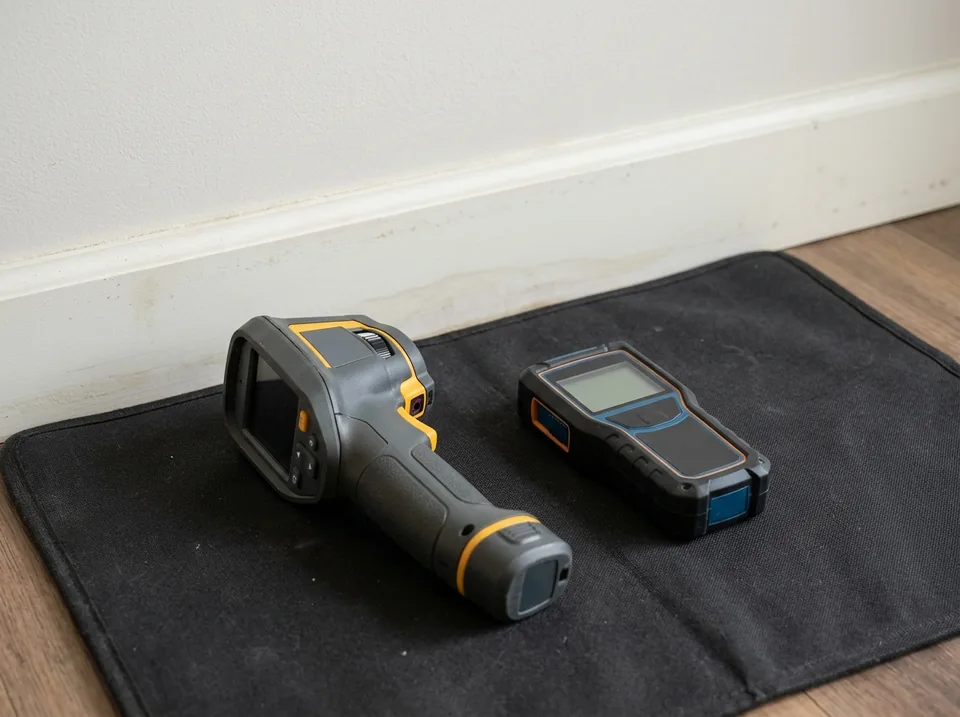
Instead, trapped water spreads laterally under the entire open-concept living area, saturating foam underlayment, turning stagnant, and wicking upward into drywall bottom plates and kitchen island bases. Independent restoration technicians use pinless moisture meters and thermal cameras to detect whether moisture is sitting under LVP or tile. In many cases, carefully unclicking and labeling salvageable floating planks—or creating controlled perimeter airflow—prevents hidden mold colonization underneath the floor.
How Do San Jacinto Permits & California Insurance Apply to Slab Leaks?
Understanding local permit rules and insurance coverage boundaries prevents unpleasant surprises during recovery. In the City of San Jacinto, emergency water extraction and dehumidification do not require building permits. However, when your plumber performs a copper-to-PEX reroute or whole-house repipe, or if major drywall and electrical reconstruction is required afterward, permits are processed online through the City of San Jacinto Building & Safety Division. Always confirm with your licensed plumbing or rebuild contractor that required permits and inspections are pulled cleanly.
On the insurance side, California homeowners policies typically separate the cause from the ensuing water damage. While many standard policies exclude the cost of repairing the corroded copper pipe itself, they often evaluate coverage for the sudden resulting water damage—including moisture mitigation, access/egress tear-out to reach the pipe, and restoring affected flooring and baseboards—provided the leak was sudden and accidental rather than a long-neglected drip. Keeping thorough Day 1 photos, plumber invoices, and daily psychrometric drying logs is critical; review our full California homeowners insurance guide for documentation tips.
How Can San Jacinto Homeowners Reduce Future Slab Leak Risk?
While no homeowner can completely stop underground soil movement, four practical maintenance habits significantly lower the odds of a catastrophic slab leak in San Jacinto:
- Test your static water pressure annually: Screw an inexpensive pressure gauge onto an exterior hose bibb. Residential pressure should typically stay between 50 and 65 PSI; readings above 80 PSI indicate a failing pressure-reducing valve (PRV) that accelerates pinhole leaks.
- Flush sediment from tank water heaters yearly: San Jacinto Valley mineral buildup settles in tank bottoms and increases thermal stress on hot-water distribution lines.
- Install smart automatic water shutoff monitors: Inline flow sensors detect unusual continuous trickle patterns and alert your smartphone—or automatically close the main valve—before thousands of gallons flood your slab.
- Watch your monthly EMWD or City water usage trend: A sudden jump of even 1,000 to 2,000 gallons in a non-summer billing cycle warrants an immediate five-minute meter check.
If you suspect a slab leak right now in Heritage, Spice Ranch, Greens of San Jacinto, or anywhere in ZIPs 92582 and 92583, shut off your main water supply and use our water damage cost calculator or call (951) 555-0194 to connect with an independent local water mitigation technician 24/7.
Frequently Asked Questions
Turn off every indoor faucet, ice maker, washing machine, and outdoor irrigation zone, then check your City of San Jacinto or EMWD water meter. If the small leak-indicator dial continues spinning, water is escaping somewhere in your supply system—often beneath the concrete slab.
Not always. While direct jackhammer access through the slab is one repair option, many San Jacinto plumbers offer overhead PEX rerouting through walls and attic spaces to bypass the failed under-slab copper line completely.
Once the plumbing leak is stopped, drying wet baseboards, lower wall framing, and sub-flooring surfaces generally takes 3 to 5 days with commercial LGR dehumidifiers and air movers, though dense concrete and hardwood can require additional monitoring.
Need an Independent Local Crew in San Jacinto?
Call (951) 555-0194 any time to connect with an independent water mitigation specialist serving San Jacinto, CA.